
Why "Because I Said So" Doesn't Work Anymore

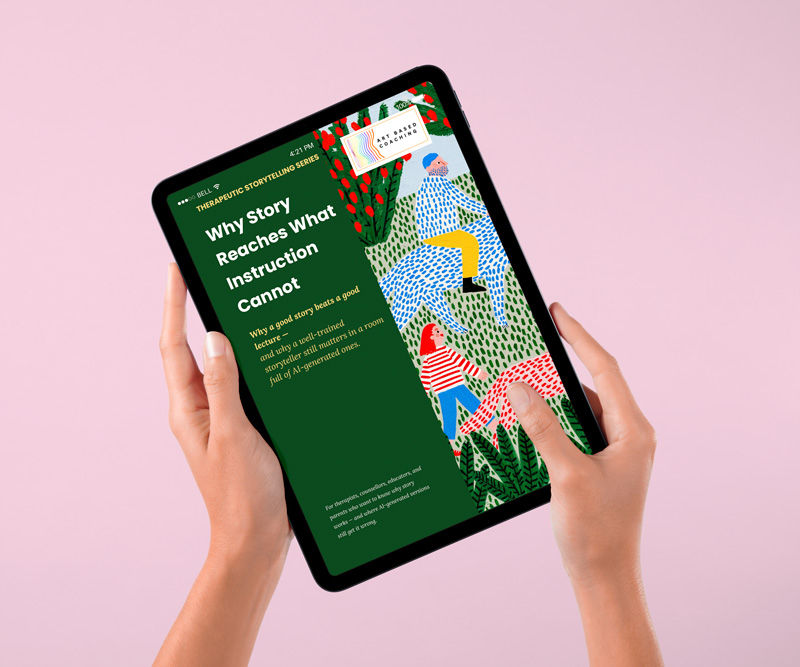
Therapeutic Storytelling Series · Part 1 of 9
A child won't get in the car for school. Logic doesn't work ("we'll be late!"). Bribery doesn't work ("ice cream after!"). The stern voice doesn't work either. Then someone tells her a two-minute story about a rabbit who was scared of a dark forest, until she found a firefly who walked beside her. The next morning, she gets in the car — holding an imaginary firefly.

That's not luck, and it isn't really about fireflies. It's about how a brain responds to being told something directly versus being shown something sideways. Once you understand the difference, you start noticing it everywhere — in classrooms, in meetings, at the dinner table.
Why does telling a child to stop being scared make it worse?
Because the brain doesn't hear it as reassurance — it hears "you're doing something wrong." That triggers defensiveness before any actual help can land. The same thing happens to adults: telling someone stressed to "just relax" rarely relaxes them. It just adds a layer of feeling judged on top of the stress that was already there.
Most of us reach for direct instruction first. It's fast, it's clear, and it's how a lot of us were raised. The problem is that authority only works while the other person agrees to go along with it. The moment a child, a client, or a team member feels talked at instead of talked with, something closes — not loudly, just quietly and completely.
Here's a way to picture it: authority knocks on the front door in a uniform, clipboard in hand. Something in the house tenses up before a single word is said. A story comes in through the side gate wearing no uniform at all — it doesn't look like it's here to inspect anything, so nobody bothers locking up.
Authority vs. story, side by side
Authority (Direct) | Story (Indirect) | |
What it says | "Here's the rule. Follow it." | "Here's what happened to someone else…" |
First reaction | Defend, or comply on the surface | Curious. Listens without bracing |
Who owns the insight | The adult hands it over | The child discovers it themselves |
Best used for | Safety rules, boundaries, stop-now moments | Fears, shame, grief — things logic can't touch |
Asked to repeat it? | Feels like nagging | Often requested again: "tell it again" |
That last row is worth sitting with. Nobody asks to hear a rule a fourth time. Children ask to hear the same story again and again — because each retelling is another pass at processing something they couldn't say out loud the first time.
Authority announces itself as a challenge to be managed, before it's even had the chance to be heard as help.
None of this means instructions are useless. Non-negotiables — don't run into the road, always wear a seatbelt — still need to be stated plainly and directly. Story isn't for the rule itself. It's for everything underneath the rule: the fear, the resistance, the shame that makes a child (or an adult) dig in rather than comply.
What this looks like in practice
The rabbit-and-firefly story above isn't a trick unique to one child. It's a repeatable mechanism: a character who quietly mirrors the real pattern, a brief and symbolic obstacle, and an ending shaped for the specific person listening. Once you can see that structure, you can start building it on purpose — for a tantrum, a transition, a team that's gone quiet after a conflict, or a grief that words keep circling without landing on.
Want the full mechanism, the framework behind it, and where it starts to break down? It's all in the free guide.


Comments