
Why Making Art Helps

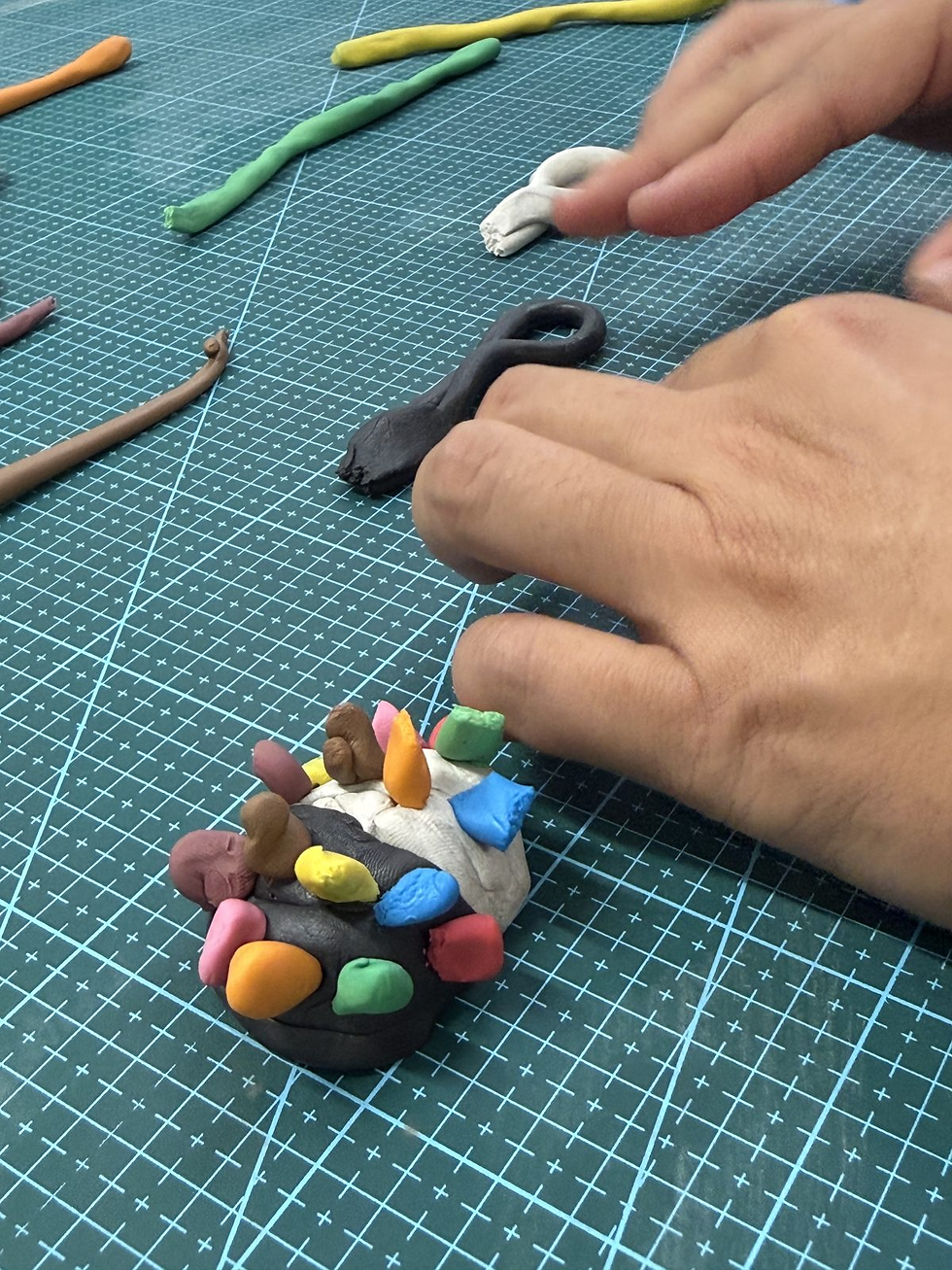
All photos in this post were taken at a live workshop led by Prof. Hildrun Rolff in our studio.

When the words will not come
Someone asks, "So how are you, really?" You open your mouth. Nothing useful comes out. Maybe a "fine", maybe a shrug, maybe a long breath.
This is not a weakness. It is not a lack of vocabulary either. It is your body doing its job.
When we are under stress, an old alarm system in the brain takes the lead. It is built to keep us safe, not to help us reflect. While it is ringing, the part of us that plans, explains and finds words has less room to work. That is why "just talk about it" so often goes nowhere.
So what helps? In this post we look at one plain answer: making something with your hands. Not because it is pretty, and not because you are good at it. Because of what happens in your body while you make.
In this post you will see:
Two ways in: from the head down, or from the body up
What one small study found after 45 minutes of making
Why a picture gives your words somewhere to start
What making art is not, said plainly
Two ways in: head first, or hands first
Think of a crying baby. Nobody sits a crying baby down and explains why there is no need to cry. We rock them, hold them, hum. The calm comes in through the body first. Only later can anything be explained.
Grown-ups have the same two doors into how we feel.
The first is top-down. You start with thinking and talking. You name the problem, explain it, make sense of it. This works well when you are calm enough to think.
The second is bottom-up. You start with the body: touch, rhythm, breath, movement. You do not argue with the alarm. You give the body steady signals that it is safe enough to settle.
Why would the body door work when the head door is stuck? Because steady, repeated movement is the grown-up version of rocking. It tells the body: nothing is chasing you right now. The alarm can stand down a little.

Same loop, again and again. The grown-up version of rocking.
Rolling a lump of clay, smoothing a surface, making the same brush stroke again and again: slow, repeated movement and touch bring your attention into your hands and into the present moment. The hands go first. The words come after.
That is the order we work in at the art table.

45 minutes, and skill made no difference
In 2016, a team at Drexel University in the United States ran a simple study. 39 adults, aged 18 to 59, spent 45 minutes making whatever they liked with markers and paper, modelling clay, or collage. Nobody told them what to make.
Before and after, each person spat into a small tube so the researchers could measure cortisol. Think of cortisol as the body's stress signal: it rises when the alarm rings and drops as you settle. About three in four people had lower cortisol after making art.

Here is the part we love. Just under half of them said they had little art experience. It made no difference. Beginners benefited as much as people who make art often. The material did not matter much either: clay, markers and collage gave similar results.
Two honest notes. This was one small study, not the final word. And about one in four people had higher cortisol afterwards. The lead researcher pointed out that this is not necessarily bad: some cortisol simply means you are awake and engaged.
So the claim is small, and it is real. You do not have to be "artistic" for making to help. You only have to begin.

The picture gives your words somewhere to start
Once the body settles, words begin to come back. And here, a second piece of research helps.
In 2007, a team at UCLA led by Matthew Lieberman scanned the brains of 30 adults while showing them photos of faces full of feeling, like anger or fear. Sometimes people picked a word for the feeling on the face. Other times they only picked a name, like "Harry" or "Sally", to match the face. Only naming the feeling made a difference: the brain's alarm centre, called the amygdala, quietened down.
In plain words: putting a feeling into words seems to turn the alarm down a little.

But naming your own feelings, out loud, to another person, is hard. Especially for many of us in Asia, where we grew up keeping the peace, saving face, and not making a fuss.
This is where the picture does its quiet work. It sits on the table between you and the person listening. You do not have to talk about yourself. You can talk about the picture: "This corner is heavy." "This line keeps running off the page." "I like this red."
Think of how teenagers often talk best in the car. Nobody is staring at anybody. You both look at the road. The picture is that road: something to look at together, so the hard thing can be said sideways.

The picture holds the feeling at a small, safe distance. You talk about the picture before you talk about you. And very often, the words you could not find a moment ago start to arrive.

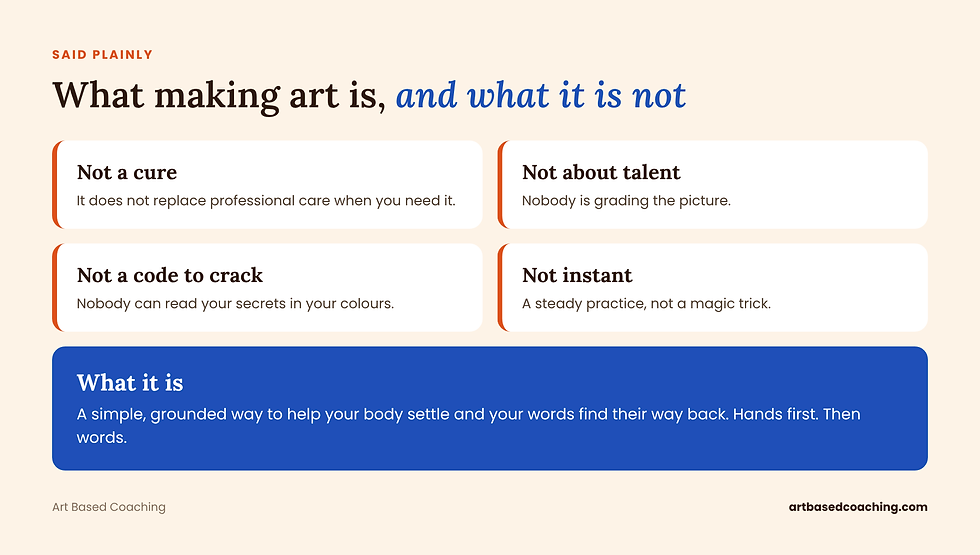
What making art is not
It would be easy to promise more here. The internet is full of "art rewires your brain" headlines. We would rather be plain with you.
It is not a cure. It does not replace professional care when you need it.
It is not about talent. Nobody is grading the picture.
It is not a code to be cracked. Nobody can read your secrets in your colours. The meaning is yours, and it is found by you.
It is not instant. It is a steady practice, not a magic trick.
What it is: a simple, grounded way to help your body settle and your words find their way back. Hands first. Then words.
I am still early on this path myself, learning from teachers who have spent decades at the art table. What strikes me most, every time, is how quickly a room goes quiet once the hands get busy. And how much easier it is to speak after.

Want to feel it rather than read about it? See our upcoming workshops at artbasedcoaching.com, or write to us at info@artbasedcoaching.com.
Missed our earlier post? Read: How Art Therapy Works, Part 1
Sources
Kaimal, G., Ray, K. & Muniz, J. (2016). Reduction of cortisol levels and participants' responses following art making. Art Therapy. Summary: Drexel University news release
Lieberman, M. D. et al. (2007). Putting feelings into words: affect labeling disrupts amygdala activity. Psychological Science. Summary: ScienceDaily
All findings are paraphrased in my own words. Photos: live workshop led by Prof. Hildrun Rolff at the Art Based Coaching studio, Petaling Jaya. Diagrams: Art Based Coaching.


Comments