

When the Skin Bears What the Mind Cannot
A True Story About How Art Therapy Helps Reconnect the Body and Mind
Begin Your Healing Journey.
What Led Her to Art Therapy
Sarah was tired of fighting her own skin as if it were an enemy, but just talking about it was never enough. She felt there were still unresolved issues deep within her body and from her childhood. She wanted a gentler way to face them.
In private art therapy sessions, she began to explore her story through clay and painting, not just through words.
Sarah (35) suffers from painful neurodermatitis, a condition that has been with her for as long as she can remember. Her skin flares up whenever life feels "too heavy": when she is overwhelmed, feels unprotected, or feels lonely.
Over the years, she learned to read her skin like a seismograph: her skin reacted even before she realized it herself.


First Session:
Clay and the Body
01
Touch and Perception
Sarah closed her eyes and placed her hands on a piece of clay. Her fingers created a tense, cracked surface – full of raised lines and tense marks, like skin that has to bear everything.
03
Gentle Care
The therapist invited her to "care for" the clay, not just shape it: to press with her whole hand, smooth and support the surface, as if giving her skin the boundaries and support it never had.
Slowly, her movements became deeper and more rhythmic.
02
The Body's Language
When invited to imagine this clay as her "skin" or her "breath," she noticed feelings of panic, helplessness, and disorientation, almost leaving her breathless.
04
A Transformative Moment
The cracks closed; the clay became thicker, calmer, more stable – Sarah felt something new in her body: "This feels so good… my body has never felt this before."
In that moment, her nervous system experienced through her hands what her skin had been trying to express for years: "I can be supported; I don't have to be on constant alert."
Second Session:
Painting and the Inner Child
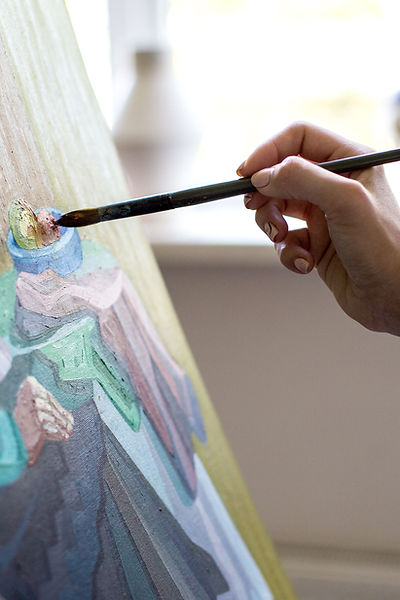
Next, Sarah was invited to "paint the scene that comes to your mind now – not what you think you should paint." Her pencil quickly sketched a narrow pier, a calm lake, and a little girl standing alone at the end, staring into the void.
Looking at the painting, Sarah realized this girl was about six or seven years old, feeling abandoned, with no one looking after her. From a developmental psychology perspective, children of this age still rely on external adults for safety and emotional support; when this is missing, the body takes over the "support" work through tension and symptoms.
Sarah recognized that this is exactly what she was still doing at 35: when feeling scared, she would panic or shut down, tensing her body, just like the girl on the pier.
When asked, "If you could visit this girl today, what would she need you to do?" Sarah placed her hand on her heart and replied: "She needs someone to say: I see you. You are not alone."
Rewriting the Story
Then she returned to the painting and changed it:
-
She widened the pier, making it sturdier and safer.
-
She added small steps – an easier, gentler path into the water.
-
She drew a second, adult figure sitting calmly nearby, present and watching over the child.
"This way the child doesn't have to carry everything alone," she explained.
This wasn't about "performing a technique"; it was her psyche correcting its own story through images.

The Language of Clay
"My boundaries can be soft yet still strong. I don't need to harden or escape my own skin."
The Language of Painting
"My inner child was once unseen and alone, but now I am here for her; she no longer has to carry everything alone."
At the end of the session, the clay relief and the updated painting were placed side by side. Looking at these two works, Sarah felt "softer," as if something was finally taking care of her – no longer just her skin trying to compensate, but her own adult self.

Therapist's Notes
(For the Reader)
This form of art therapy is not about "fixing" someone from the outside; it creates a space where the body and images can meet, allowing healing and maturation to grow from within.
01
Symptoms as Messengers
Symptoms (Sarah's skin condition) are not seen as "a problem to be eliminated," but as messengers indicating where support and boundaries are lacking.
02
New Bodily Experiences
Through the clay, her body learned new experiences of being supported and held.
03
Healing the Inner Child
Through painting, her inner child received the presence and protection she once needed, now provided by her adult self.
Simple Session Flow
