
Bibliotherapy, Play Therapy, and Therapeutic Storytelling: What's the Difference?

Therapeutic Storytelling Series · Part 3 of 9

If therapeutic storytelling sounds unfamiliar, here's the reassurance: it isn't a stand-alone gimmick. It belongs to a recognised family of techniques that all work the same way — by helping someone process something painful through a character, a toy, or a page that isn't them.
Is therapeutic storytelling the same as play therapy?
No, but they're siblings. Both rely on the same shared mechanism: symbolic distance. A feeling too raw to say aloud gets placed onto something that isn't the person, so there's nothing to defend against — and the real work happens anyway. Where they differ is who builds the story and what it takes to practise safely.
Three techniques, one family:
What it is | What it needs | |
Bibliotherapy (the oldest sibling) | "Book healing" — using a person's relationship with a written text to help them process something. Studied since the early 1900s. | A book already written, matched to the reader |
Play therapy (the sibling who works with their hands) | A child moves a figure through a sand tray or dollhouse, acting out the exact fear or conflict they can't say aloud. The therapist mostly witnesses. | Years of clinical training, a dedicated room, sand tray or dollhouse |
Therapeutic storytelling (the sibling who improvises) | Instead of waiting for the right book or the right scene in a sand tray, the story is built live, in the room, matched precisely to the person in front of you. | A focused training and a few minutes — no equipment |
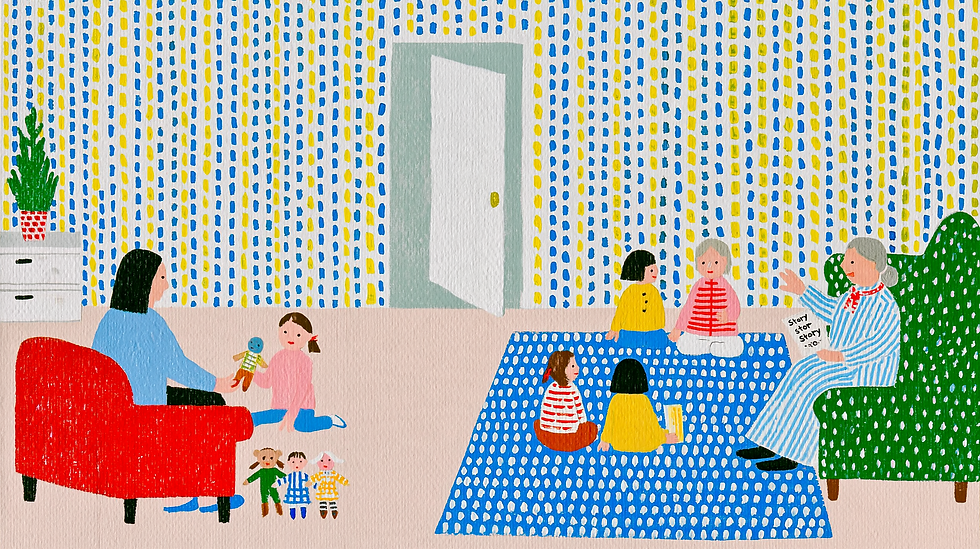
A book gives someone else's story to sit with quietly. A sand tray lets a child build their own. A therapeutic story is built for them, on the spot.
What is bibliotherapy?
It's the oldest of the three, dating back to the early twentieth century — using a reader's relationship with an existing text to help them process something. It's a wonderful entry point, but it depends on finding a book that already fits the exact pattern in front of you, which isn't always possible.
What is play therapy?
A genuinely skilled clinical craft. A child moves a figure through a sand tray or dollhouse and, without realising it, acts out the fear or conflict they can't say out loud, while the therapist mostly witnesses rather than directs. It typically takes years of supervised clinical study — which is exactly why trained play therapists are worth what they cost.
Therapeutic storytelling fills a different, more immediate gap. A teacher facing a tense classroom on Monday morning, a parent at bedtime, a manager after a team conflict — none of them have years to invest before they need something that works. This is the sibling that meets that need: same family, same underlying mechanism, but usable the same day it's learned.
See the full "one family, two branches" breakdown — including where therapeutic storytelling stops being safe to improvise without training.
FAQ NOTE:
Q: What is bibliotherapy? Q: What is play therapy? Q: Is therapeutic storytelling the same as play therapy? (Answers already covered in body copy above.)
NEXT IN THIS SERIES: Part 4 — How One Story Can Reach a Whole Classroom (Without Singling Anyone Out)
AUTHOR BIO:
Written by Lee Ling, Art Based Coaching — works across art therapy practice and coaching, and is pursuing a counselling master's in Malaysia.


Comments