
Top Down, Bottom Up: Two Roads To Change

Some Change Starts In The Head. Some Starts In The Body.

Two floors, one lift. The head and the body are always talking to each other, in both directions.
"Just calm down."
We have all said it to a worried friend. Or heard it ourselves. Did it ever work?
Almost never. The words were kind and correct. But the heart was still racing, and the shoulders were still up near the ears. The words went in through the head. The worry was living in the body.
Here is the big picture.
There are two roads to change.
Top down starts in the head: thoughts, words, plans.
Bottom up starts in the body: breath, movement, the hands. Most of us were only ever taught the first road.
That is why some things refuse to move, no matter how well we understand them. Let us walk down both roads, one at a time.
Two Roads, One Building
Picture ourselves as a building with two floors.
The top floor is the thinking mind. Words, plans, reasons, "I should" and "I must."
The ground floor is the body. Heartbeat, breath, a tight stomach, cold hands, the urge to run or to freeze. The need-to-pee before presentation.
The two floors are connected by a lift. It goes both ways.
Top down means starting upstairs. We use thoughts and words to calm or guide the body.
Bottom up means starting downstairs. We work with the body first, and the thinking mind follows.

Each of us is a two-floor building. The lift between head and body is always moving.
Neither road is better. They simply start in different places. The trick is knowing which floor the problem lives on.
Top Down: Starting With The Head
Most of the advice we grow up with is top down. Think positive. Make a list. Be more disciplined. Talk it through. Look at the facts.
These are good tools, and they work well when the problem lives upstairs. If we are confused about a plan, talking it through helps. If we forgot a deadline, a reminder helps. The head understands, and the body goes along.

Top down: the idea comes first, and the hands follow.
But sometimes we understand perfectly and still cannot move. We know the task is not dangerous. We know we are able to do it. And still, the body says no.
That is the sign that the lift needs to start from the other floor.
Bottom Up: Starting With The Body
Bottom up starts with what the body is doing right now. A slow breath. Feet pressing into the floor. Hands moving. A rhythm. The weight of something held.
Go back to the worried friend. Instead of saying "calm down," we sit next to them. We breathe slowly. We hand them a warm cup of tea. Nobody explains anything. And yet, a few minutes later, their shoulders come down.

No speech needed. A warm cup and a quiet friend can reach the ground floor first.
Nothing was argued. The body was given a different experience, and the body changed first. Then the friend can think clearly again.
This is not magic. The body is always sending signals up to the brain, and the brain uses them to decide how we feel. When the signals coming up change, the feeling changes too.
Why Some Things Do Not Move With Words
Many of our patterns were learned downstairs, long before we had the words to explain them.
A child who was scolded every time they got something wrong does not write down a rule. The body simply learns: trying is risky, so better not start. Years later, as an adult, that same body pulls the brake whenever a task feels like it could be judged.
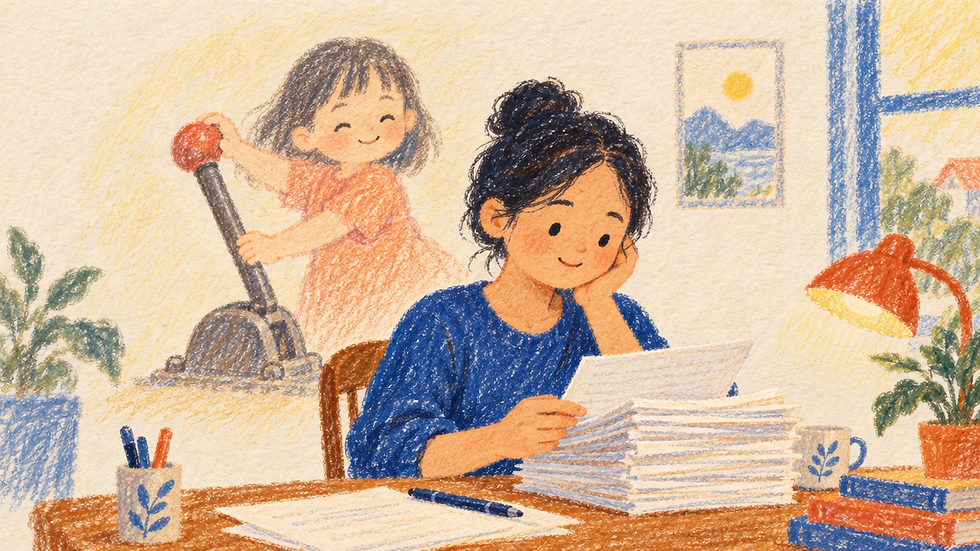
The brake was put there long ago, to keep a younger self safe. It was never there to block us.
From the outside, it looks like laziness. From the inside, it feels like a wall we cannot explain.
This is why top-down advice, however wise, sometimes does not reach. "Just be disciplined" is a message sent from the top floor. But the brake was pulled on the ground floor. It is a kind message, sent in a language the ground floor does not speak and cannot understand.
What was learned through the body often needs a road back through the body.
Where Art Based Work Sits: Both Roads Meet On The Paper
Art based work uses both floors, in a gentle order.
It starts bottom up. We pick up a crayon. The hand moves. We feel how hard we press, how fast or slow the line goes, which colour the hand reaches for. None of this needs words. The body is doing the talking.

First the hand moves. Then we can see it. Then we can work with it.
Then something shows up on the paper. A heavy dark corner. A line that stops halfway. A small shape far away from everything else.
Now the lift can go up. The head can look at it. What was only a feeling in the body is now something we can see. And what we can see, we can work with.
That is why we say art based work is making sense by making. We are not looking for a beautiful picture. Nobody tells us what our drawing means. We simply give the body a way to speak first, so the mind has something real to listen to.
Top Down And Bottom Up, Side By Side
Both roads are good roads. They simply start on different floors.
Top Down | Bottom Up | |
Starts on | The top floor: the thinking mind | The ground floor: the body |
Speaks the language of | Words, reasons, plans | Sensation, movement, rhythm, touch |
Everyday examples | Making a list, talking it through, a pep talk | A slow breath, a walk, a warm cup of tea, a crayon in the hand |
Helps most when | We need clarity about a plan or a fact | We understand, but the body still says no |
Feels like | "Now I understand it" | "Something just shifted" |
In art based work | Looking at the drawing and noticing what it shows | Making the drawing, before any words |
Prefer to see it all at once? Here is the whole idea on one page.
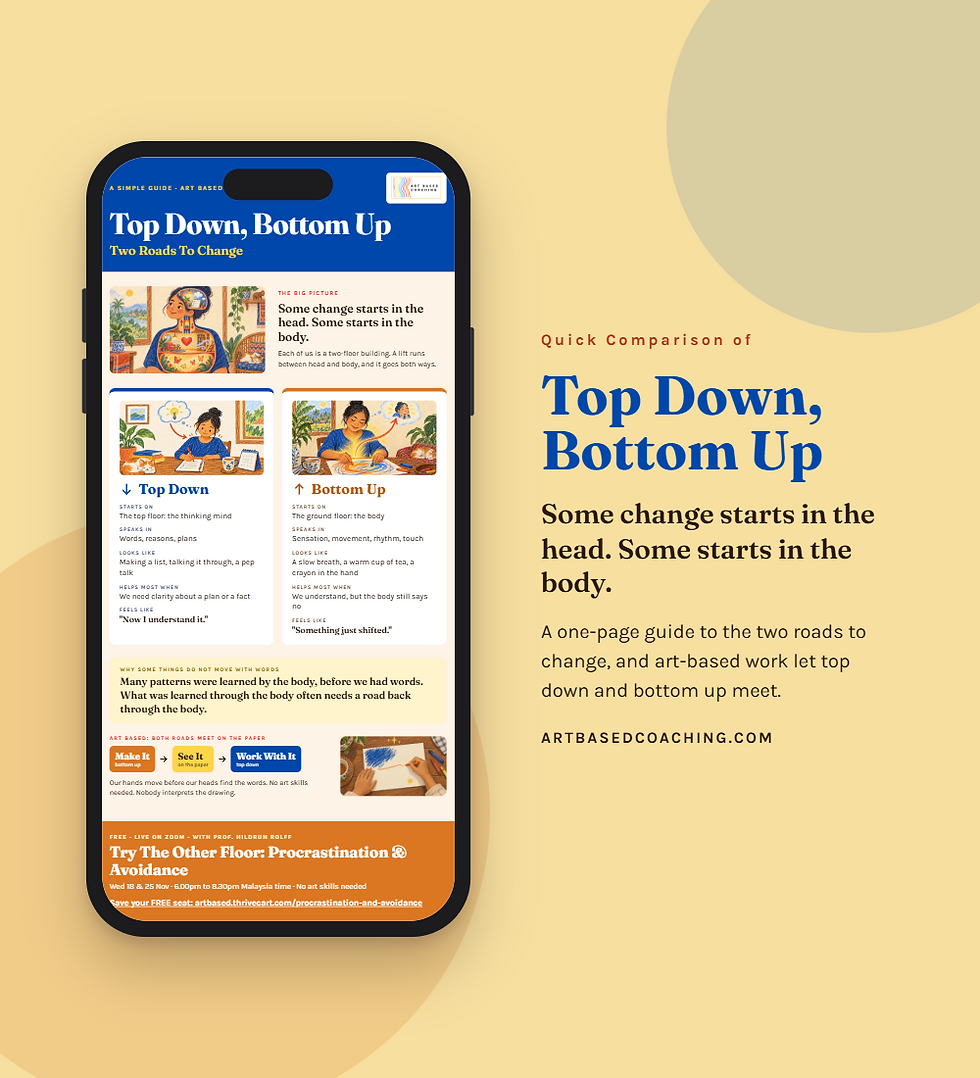
Click the image to download as pdf : "Top Down, Bottom Up: the whole idea on one page".
Try The Other Floor
If something keeps moving to esok, it may not need more willpower from the top floor. It may need a visit to the ground floor.
We do not need to be an art therapist or a sensorimotor expert to use a body-based approach. Prof. Hildrun, who joins us from Germany, will show us how it works, for FREE. Come and experience it with an open heart.
On Wednesday 18 November, Prof. Hildrun Rolff opens our series Art Based Approaches To Emotional And Relationship Challenges with Procrastination & Avoidance. Prof. Hildrun brings 40 years in art therapy and sensorimotor, trauma-informed work. Part 1 is for ourselves. Part 2, on 25 November, is for the children in our lives, or the child we once were.
Experience it yourself, then use it on your loved one or client.
Both evenings are free, live on Zoom, 6.00pm to 8.30pm Malaysia time. No art skills needed.


Comments